It’s the first properly hot week of December. The split system in the lounge room is running flat out, and the air coming out feels more like a fan than an air conditioner. Someone at a barbecue tells you it “just needs a regas”, so you start looking up split system regas cost. Fair enough. The catch is that the gas itself is rarely the part of the bill that matters.
Most of what you’ll find online about regas pricing is written for cars, and home air conditioners work differently. Here’s what the job involves on a split system, what pushes the price up or down, and how to tell if paying for it makes sense at all.
A split system should never need topping up
The refrigerant in your air conditioner (people call it “gas”) travels in a sealed loop of copper pipe between the indoor and outdoor units. It soaks up heat inside your home and dumps it outside, over and over. It doesn’t burn and it doesn’t get used up the way petrol does.
So if a system is low on gas, some has escaped. There’s no other explanation.
Car air conditioning is a different story. It runs through rubber hoses and seals that get shaken about on the road, so a slow loss over the years is normal and a regas every so often is routine maintenance. That’s why car regas prices are easy to find. A home system that has lost gas has a fault, and the price depends on finding that fault.
You’re paying to find the leak, not to buy the gas
A proper refrigerant repair on a split system usually runs in this order:
- Confirm it really is gas. A lot of “it needs gas” call outs turn out to be clogged filters, a dirty indoor coil or a blocked outdoor unit. Our checklist for an AC that isn’t blowing cold air covers the common ones.
- Find the leak. Usually with an electronic leak detector, bubble solution on the joints, or by pressure testing the system with nitrogen and watching whether it holds.
- Fix it. Re-making a flare joint (the screwed copper fittings where the pipes meet each unit), replacing a damaged section of pipe, or in the worst case replacing a coil.
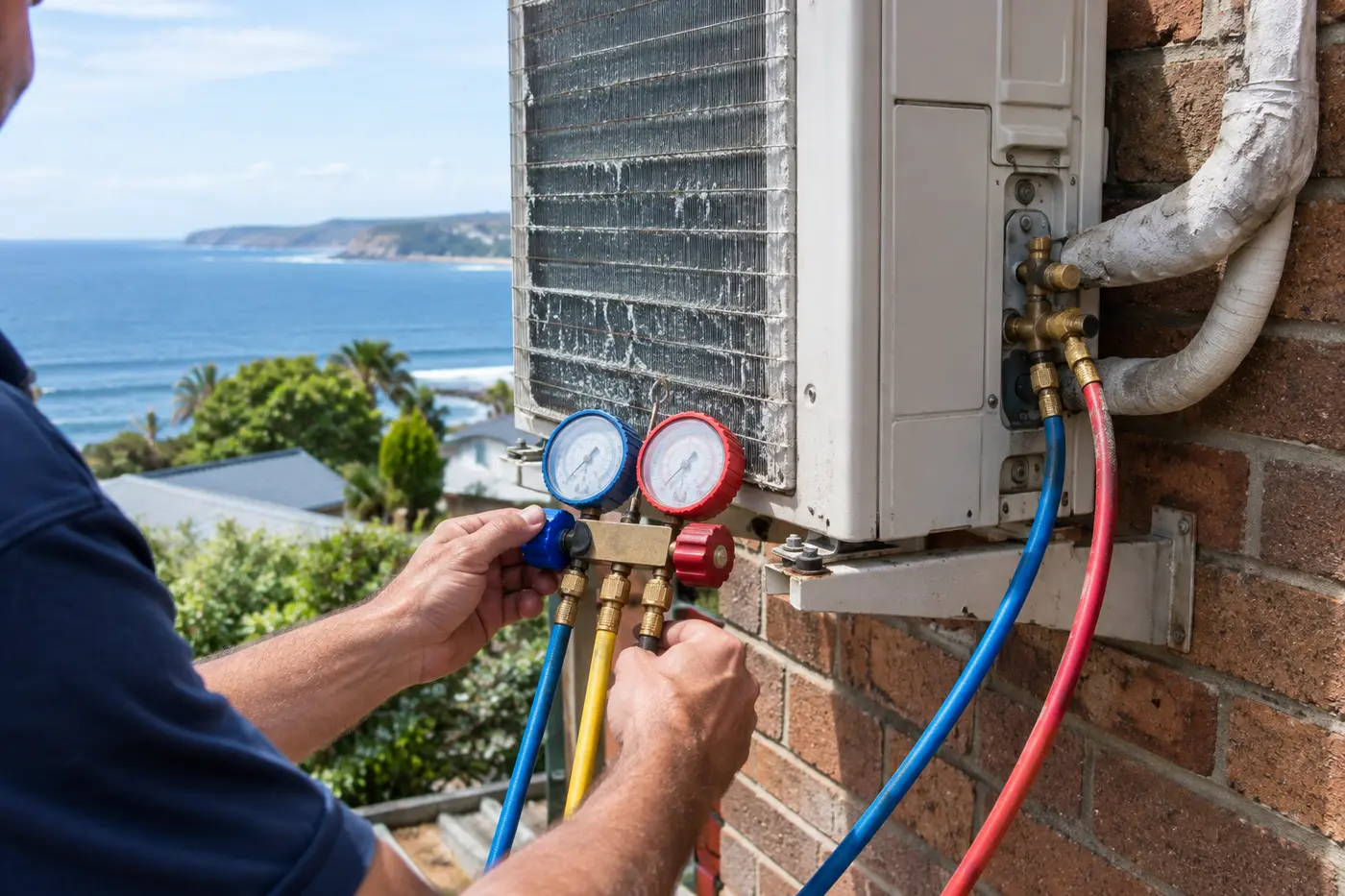
- Pull a vacuum. A vacuum pump draws out air and moisture. Moisture left inside mixes with the refrigerant and oil and damages the compressor over time.
- Recharge by weight. The correct amount is printed on the unit’s compliance plate. A good technician weighs it in rather than guessing from pressure readings.
Steps two and three are where the time goes, and they’re the reason nobody can honestly give you a firm regas price over the phone before anyone has looked at the system. If you’d like someone to run through those steps on your unit, our split system and ducted repair service starts with the diagnosis, and you get a quote before any repair work begins.
Four things that move the price
Where the leak is
A loose or cracked flare joint you can reach from the outdoor unit is a quick fix. A pinhole in the indoor coil, or a leak in pipework that runs inside a wall cavity, takes far more time. Sometimes it means a new coil, and on an older unit that can tip the decision toward replacement.
What type of refrigerant it uses
Newer split systems mostly run on R32 and slightly older ones on R410A. Both are readily available. Units from the early 2000s and before often use R22, which has been phased out in Australia. What supply is left is scarce and dear, so topping up an R22 system costs well above the newer gases. The refrigerant type is listed on the compliance plate on the side of the outdoor unit.
How easy the units are to reach
An outdoor unit sitting on a slab beside the house is simple. One bolted high on a second storey wall, or up on a roof, needs extra time and sometimes extra safety gear.
How much gas the system holds
A small bedroom split holds a lot less refrigerant than a large living area unit, and long pipe runs between the indoor and outdoor units add more on top. The gas is usually the smaller cost, but it still scales with system size.
Salt air is often the culprit on the coast
Plenty of the refrigerant leaks we find near the water trace back to corrosion. Salt spray settles on the outdoor unit’s coil and copper pipes. Over years it eats away at the metal until a pinhole opens up somewhere, often in a spot you can’t see without pulling panels off. Homes a street or two back from the beach in places like Terrigal, The Entrance or Umina Beach cop it far worse than those further inland.
That’s one reason a routine service includes cleaning the outdoor coil and checking the refrigerant lines for damage. Catching corrosion early costs a lot less than chasing a leak through a coil that’s already failing.
When a regas is worth it, and when it isn’t
A refrigerant repair is usually good value when the system is fairly new, runs on R32 or R410A, and has one leak that can be found and fixed. Once that’s done it should hold its charge for years, because the loop is sealed again.
It’s harder to justify on an R22 unit, on a system that has already been topped up once or twice, or where the leak is in a badly corroded coil on an older unit. In those cases the money is often better spent toward a new system. Our guide to deciding whether to repair or replace an air conditioner works through that decision in more detail.
The option to avoid is the “top up and go” job, where gas goes in and nobody looks for the leak. It might cool nicely for a few weeks or a whole summer, then the gas escapes again and you pay a second time. Meanwhile a system running short on refrigerant makes the compressor work harder and run hotter, and the compressor is the most expensive part in the whole unit.
How to tell if your system is actually low on gas
Low refrigerant has a few telltale signs. The unit runs for hours without the room ever reaching the set temperature. You might see frost or ice on the indoor coil, or on the thicker copper pipe where it joins the outdoor unit. That ice can melt and drip from the indoor unit, which is easy to mistake for a drain problem. Some leaks make a faint hissing or bubbling sound, and your power bill may creep up because the system never gets a rest.
A dirty filter or a clogged coil can cause nearly all of the same symptoms, which is exactly why step one of any refrigerant job is ruling those out. Nobody wants to pay for leak detection when the real fix is a clean.
Refrigerant work needs a licence, for good reason
In Australia, anyone who handles refrigerant needs a refrigerant handling licence from the Australian Refrigeration Council. Refrigerants are powerful greenhouse gases, so letting them vent into the air is illegal, and R32 is mildly flammable. The regas kits sold online are made for car systems. They have no place on a home split system.
When you’re getting a quote, three questions sort out the careful operators quickly. Will you find and fix the leak before recharging? What refrigerant does my unit use? Will you weigh the charge in to the compliance plate figure? If the answer to the first one is vague, keep looking.
If your split system has lost its bite before summer arrives, book an air conditioning repair with our team. We’ve been working on air conditioners across the Central Coast for over 15 years, and we’ll tell you what’s wrong and what it will cost to fix before any repair starts.
Common questions about regassing an air conditioner
How much does it cost to regas an aircon?
For a home split system, the gas is usually the smaller part of the bill. Most of the cost is labour to find and repair the leak, then vacuum and recharge the system. That varies with where the leak is, what refrigerant the unit uses and how easy the units are to reach, so a fair price comes after a technician has diagnosed the fault.
Is it worth getting aircon regassed?
Yes, if the leak is found and repaired at the same time and the unit is in otherwise good shape. A top up without fixing the leak is rarely worth it, because the gas escapes again. On an older R22 system or one with a corroded coil, putting the money toward a replacement is often the better call.
Can I refill AC gas myself?
No. In Australia, handling refrigerant requires a licence from the Australian Refrigeration Council, and releasing it is illegal. The DIY kits sold online are designed for cars, not home split systems, and some household refrigerants are mildly flammable.
How do I tell if my AC is low on refrigerant?
Look for weak cooling despite long run times, ice or frost on the indoor coil or copper pipes, water dripping after that ice melts, or a hissing sound near the pipework. Rule out a dirty filter first, since it can cause very similar symptoms.
How often does a split system need a regas?
Ideally never. The refrigerant runs in a sealed loop, so a healthy system keeps the same charge for its whole life. If yours needs gas, it has a leak, and that leak is the real repair.
What is the 3-minute rule for air conditioners?
Most systems wait about three minutes before restarting the compressor after they’ve been switched off. The pause lets the pressures inside the system even out so the compressor isn’t forced to start under strain. It’s why your unit may sit quietly for a few minutes after you turn it back on, and why flicking it on and off repeatedly doesn’t help.