It’s a warm afternoon, the house is finally cooling down, and then the air conditioner goes quiet. A few minutes later it starts up again. Then it stops. If your air conditioner keeps turning on and off like this, you’re not imagining it, and it’s worth paying attention to. We get this call a lot once the humid weather arrives on the Coast, and the cause ranges from a setting on the remote to a fault that will get more expensive the longer it runs.
The trade name for it is short cycling: the system starts, runs for only a short time, shuts off before it has properly done its job, and repeats. Here’s how to tell normal behaviour from a problem, what you can safely check yourself, and what needs a technician.
Some stopping and starting is completely normal
Before anything else, it helps to know what your system is supposed to do.
An older non-inverter unit only has two speeds: flat out or off. Once the room reaches the temperature you set, the compressor (the motor in the outdoor unit that does the heavy lifting) switches off. When the room warms up again, it switches back on. So a non-inverter system will always cycle. What matters is the pattern. Long, steady runs with breaks in between are fine. Bursts of a few minutes on, a few minutes off, while the room never really gets comfortable, is short cycling.
Inverter systems are different. They slow the compressor down instead of stopping it, so once the room is at temperature they tick along quietly in the background. If you have an inverter unit and it’s starting and stopping all afternoon, that’s more of a red flag than it would be on an older machine. Our guide to inverter and non-inverter units explains the difference if you’re not sure which one you have.
One more normal one, and this surprises people every winter. In heating mode, a reverse cycle system periodically pauses to defrost the outdoor coil. The indoor fan stops, the outdoor unit may hiss or even let off a little steam, and after a few minutes heating resumes. On cold mornings up around Kulnura and Mangrove Mountain you’ll see it more often than you will in Terrigal. That’s the system looking after itself, not a fault.
Things worth checking before you call anyone
None of these involve opening the unit or touching anything electrical. They’re the same checks we’d run through first, and every so often one of them solves it on the spot.
- The remote settings. A sleep mode, eco mode or on/off timer can make a unit stop and start in ways that look like a fault. Check nothing is set that you didn’t intend.
- The set temperature. If the target is only a degree or two away from the room temperature, the system will reach it quickly and switch off, especially on a non-inverter unit.
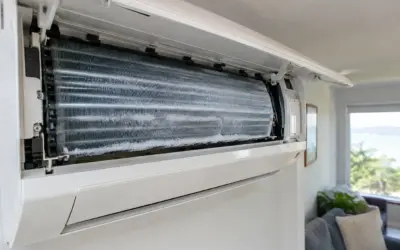
- The filters. Clogged filters starve the indoor coil of air. That can cause it to get too cold and trip its own protections. Most split system filters slide out from behind the front panel and rinse clean.
- The outdoor unit. Look for leaves, a bin pushed up against it, or plants grown over the fins. If it can’t get rid of heat, it can overheat and shut itself down.
- Where the sensor or controller is. A ducted wall controller in direct afternoon sun, or a split system blowing straight back onto itself in a small room, can get a false reading and shut off too early.
If one of those was the culprit, give the system a day of normal use and see if it settles. If not, the cause is almost certainly inside the system.
The causes that need a licensed technician
Once the simple stuff is ruled out, these are the faults we most often find behind short cycling.
Low refrigerant from a leak
Refrigerant is the gas that carries heat out of your home. If some has leaked out, pressures inside the system drop and the safety controls start shutting the compressor down to protect it. Often you’ll also notice weaker cooling, or ice forming on the pipes or the indoor coil. We cover that side of things in our post on why an air conditioner freezes up. Handling refrigerant requires specific licences, so this one is never a DIY job, and simply topping it up without finding the leak just puts off the same visit.
An oversized system
Bigger is not better. A unit that’s too powerful for the room cools the air so fast that it hits the set temperature and stops before it has run long enough to pull moisture out of the air. On the Central Coast, where summer humidity is the real enemy, that leaves rooms feeling cold and clammy at the same time. If your unit has short cycled since the day it went in, sizing is the first thing we’d look at.
Electrical and sensor faults
A failing temperature sensor, a loose connection or a fault on the control board can all tell the system to stop when it shouldn’t. Salt air doesn’t help here. Corrosion on outdoor unit connections and coils is something we see in homes close to the water, and it tends to show up as intermittent faults that come and go before they become permanent.
A compressor that’s overheating
Compressors have built-in overload protection. If the outdoor unit is struggling, whether from dirty coils, a failing fan motor or poor airflow in a tight side passage, the compressor can get hot enough to switch itself off, cool down, start again and repeat. Left alone, that cycle wears the compressor out, and it’s the most expensive part in the system to replace.
Why it’s worth fixing sooner rather than later
Starting up is the hardest moment in a compressor’s life. Every unnecessary start adds wear, uses a burst of extra power and puts strain on the electrical components. A system that short cycles through a whole summer is using more electricity to keep you less comfortable, and it’s ageing faster than it should.
It can also affect your warranty. Many manufacturers require proof of regular professional servicing to keep the warranty valid, so if your system is still covered, getting it looked at properly (and keeping the paperwork) protects you if the fault turns out to be a major part.
When we come out for an air conditioning repair on the Central Coast, we check the settings and sensors, test refrigerant pressures, look at the electrical connections and outdoor unit, and watch the system run through a few cycles. That way we fix the cause, not the symptom.
Common questions about air conditioners that keep switching off
What does it mean when your air conditioner keeps turning off?
Usually that something is telling the system to stop before it has finished. It might be a timer or sleep setting, a sensor getting a false reading, or a safety control shutting the compressor down because of low refrigerant, overheating or an electrical fault. If the settings and filters check out, it needs a proper diagnosis.
What is the 3 minute rule for AC?
Most systems have a built-in delay of around three minutes before the compressor will restart after it stops. It lets pressures inside the system even out so the compressor isn’t forced to start under load. It’s also why your unit may not respond straight away after you switch it off and on again, which is normal.
Should you turn off AC if it is short cycling?
If it’s happening constantly, yes, it’s sensible to switch it off until it’s been checked, especially if you can see ice, hear unusual noises or smell burning. Every extra start wears the compressor. If the weather makes that impractical, run it for shorter periods and book a service rather than leaving it to cycle all day.
What is the most common cause of short cycling?
In the homes we visit, blocked filters and poor airflow are the most common simple causes, and low refrigerant from a leak is the most common fault inside the system. An oversized unit is the usual explanation when the problem has been there since installation.
Why does my outside unit keep turning on and off?
In heating mode, the outdoor unit stopping and starting is often just the defrost cycle, which is normal on cold mornings. In cooling mode it more often points to the compressor overheating, a refrigerant problem or an electrical fault, so it’s worth getting looked at.
If your system is still stopping and starting after the basic checks, don’t let it wear itself out through summer. With over 15 years of experience on the Central Coast, our team can find out what’s really going on. Book a repair visit and we’ll get it running properly again.