Most of the ducted systems we get called out to on the Central Coast haven’t actually broken down. They’ve just got a little worse every year. The back bedroom never quite cools. There’s a musty smell for the first few minutes after you switch it on. The power bill creeps up and nobody can say why. That slow slide is what ducted air conditioning maintenance is really about, and it’s easy to miss because almost every part of the system sits out of sight in the roof.
Below we cover what’s actually up there, the few jobs an owner can sensibly take on, what a professional service involves on a ducted system, and the signs that yours is overdue.
Almost everything that needs looking after is hidden in the roof
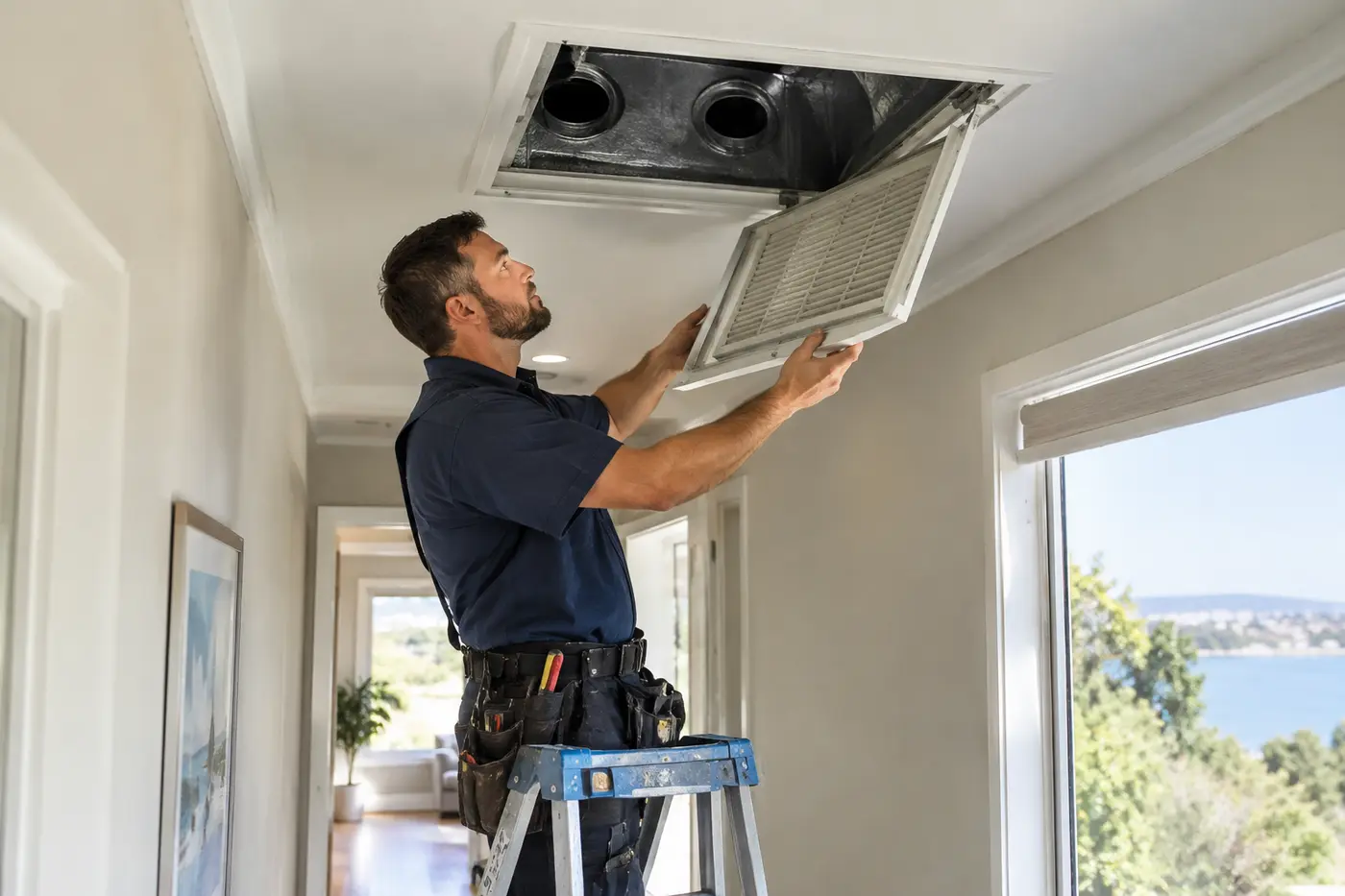
A wall split system puts its filter right in front of you. Every time you look at the unit, you’re reminded it exists. A ducted system is different. From inside the house you see a controller on the wall, a row of outlets in the ceilings and one large return air grille, usually in a hallway. That grille is where the system draws air back in, and it’s where the main filter lives.
The rest is above your head. The indoor unit (often called the fan coil) sits in the roof space and holds the evaporator coil, which is the part that actually cools or heats the air, plus the fan that pushes air through the ducts. Insulated flexible ducts run from there to each outlet. If you have zones, small motorised flaps called dampers open and close inside the ducts to send air only where you want it. Under the indoor unit there’s normally a safety tray to catch any water if the main drain blocks. Outside, the outdoor unit does the heavy lifting of moving heat in or out of the house.
None of that gets looked at unless someone climbs into the roof on purpose. In a lot of homes, nobody has since the day it was installed.
Coastal air is harder on a ducted system than most people expect
Humidity is the big one. When the coil cools humid air, water condenses on it and runs away through the drain. That constant dampness is exactly what mould likes, and a coil and drain that stay wet and dusty become the source of that start-up smell. Dust and pollen add to it. Because the whole house breathes back through a single return grille, that one filter does a lot of work.
Outside, salt air settles on the outdoor unit’s coil and metalwork. Homes close to the water in places like Terrigal, Avoca Beach and The Entrance tend to see corrosion sooner than homes further inland. Leaves and garden growth around the outdoor unit are a common problem in leafier suburbs too, because they choke the airflow it relies on.
Then there’s the roof itself. It’s hot, it’s dusty, and it’s sometimes shared with rats or possums who are happy to chew through a flexible duct. A split or disconnected duct can quietly dump cooled air into the roof space for months before anyone works out why one room never gets cold.
Three jobs that are genuinely yours
The return air filter is designed to be cleaned by the owner. Check your system’s manual for how your grille opens and whether the filter should be vacuumed or washed. If you wash it, let it dry completely before it goes back in. A filter that’s clogged with dust starves the whole system of air, and it’s the single most common reason we find a ducted system working harder than it should. Look at it at the start of each season, and again partway through a long hot summer if the house is dusty or you have pets.
Keep the airflow paths open. Outlets blocked by tall wardrobes and a return grille hidden behind a door that’s always shut both cut performance. Outside, give the outdoor unit room to breathe: trim back plants, and don’t stack outdoor furniture or bins against it.
And run it before you need it. Switch the system on for a while in spring, before the first hot week. Walk through each zone. Listen for rattles or squeals, and notice any smell. Spotting a problem now is a lot more pleasant than spotting it on the hottest afternoon in January.
That’s where the owner’s list stops. Climbing into the roof to spray cleaner on the coil, poking at the indoor unit or trying to top up gas are jobs for a technician. Refrigerant handling requires specific licences, and a roof space full of electrical wiring and thin ceiling plaster is no place to learn.
What a proper ducted service actually covers
A good service on a ducted system is more than a filter clean. When we do a professional ducted air conditioner service, the routine is tailored to the system type, and on a ducted unit it typically includes:
- cleaning or replacing the return air filter
- inspecting and cleaning the evaporator coil
- cleaning and flushing the condensate drain line so it doesn’t block and overflow
- inspecting and cleaning the fan barrel (the blower wheel), and listening for unusual noise or vibration
- cleaning the outdoor coil and checking the fan motor and blades for wear
- inspecting refrigerant lines for leaks or damage and confirming the system has the correct charge
- checking wiring, terminals, capacitors and contactors for wear or corrosion
- testing the controller and its temperature reading
- measuring airflow, which is where problems in the ductwork usually show up
On a ducted system, weak airflow at one or two outlets is often the clue to look further. That can mean a duct that’s kinked, split or come loose at a joint, or a zone damper that’s stuck. If you have a zoned system and one zone has stopped responding, our guide on how ducted zoning works on the coast explains the parts involved.
One more reason to keep servicing regular: many air conditioner manufacturers require proof of regular professional servicing to keep the warranty valid. Keep your invoices somewhere you can find them. If you’re budgeting for it, we’ve broken down what a service typically costs locally in a separate post.
Once a year is the baseline, and spring is the right time
We recommend a professional clean at least once a year. If the system runs every day, if you have pets or allergies, or if your home sits in one of the more humid pockets of the coast, more often makes sense. The timing matters almost as much as the frequency. A service in spring means any fault gets found while it’s still mild outside. Leave it until the first heatwave and you’re competing with everyone else whose system has just failed.
Signs your ducted system is overdue
Some of these creep up so slowly you stop noticing them. Others need attention straight away.
- rooms at the end of a duct run that used to cool well and now don’t
- a zone that won’t turn on or off from the controller
- a musty or damp smell when the system first starts
- rattling, squealing or banging from the roof
- rust or white crusting on the outdoor unit
- the system running for long stretches without reaching the set temperature
- power bills rising when your use hasn’t changed
- a water stain, drip or sag in the ceiling near the indoor unit
That last one is the urgent one. Water in the ceiling usually means the drain and safety tray have both blocked or overflowed. Turn the system off, keep people out from under any sagging plaster, and call a technician rather than running it to see if it stops.
Duct cleaning is a separate question
People often ask whether their ducts need cleaning every year. Usually they don’t. The return air filter is there to stop most dust reaching the ducts in the first place, which is another reason to keep it clean. Ducts are worth a closer look if there’s been a rodent problem in the roof, after renovation work that filled the house with dust, if mould has been found in the system, or if the system has sat unused for a long time. If we see signs of that during a service, we’ll tell you.
Getting it booked
Our team has more than 15 years of experience on the Central Coast, and a lot of that time has been spent in roof spaces looking at ducted systems nobody had checked since installation. If yours hasn’t had a professional look in the last year, now is a good time to book a ducted air conditioning service before summer arrives.
Common questions about ducted air conditioning maintenance
How do you service a ducted aircon?
A technician cleans the return air filter, then works through the indoor unit in the roof (coil, fan and drain) and the outdoor unit (coil, fan and electrical parts). They also check the refrigerant charge, test the controller and measure airflow to pick up duct or damper problems. Owners should stick to the filter and keeping outlets and the outdoor unit clear.
How often should ducted air conditioning be serviced?
At least once a year for most homes. If the system runs daily, you have pets or allergy sufferers, or you live somewhere humid, more often is worthwhile. Spring is the best time, before the first run of hot weather.
Do ducted air conditioners need to be cleaned?
Yes. The filter, evaporator coil and drain all collect dust and moisture, and on the coast that combination encourages mould and smells. The ducts themselves usually don’t need cleaning every year unless there’s been mould, rodents or heavy renovation dust.
Can I clean my ducted air conditioning filter myself?
Yes, the return air filter is designed to be cleaned by the owner. Follow your manual for how to open the grille and whether to vacuum or wash it, and make sure it’s completely dry before refitting. Anything beyond the filter, especially in the roof space, is a job for a technician.
Will skipping servicing affect my warranty?
It can. Many manufacturers require proof of regular professional servicing to keep the warranty valid, so skipping it could leave you paying for a repair that would otherwise have been covered. Keep your service invoices.
What does ducted air conditioning maintenance cost?
It depends on the size of the system, how easy the roof space is to get into and what condition the unit is in. We give transparent, upfront quotes so you know where you stand before any work starts.