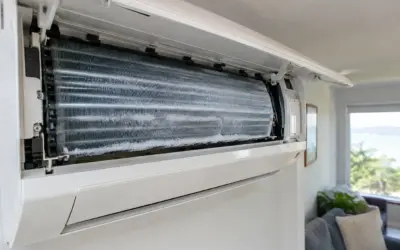
Most summers we get a call that goes something like this. The old wall unit in the bedroom blasts icy air, the room gets cold, the unit shuts off with a clunk, the room warms up again, and not long after it roars back to life. Nobody is sleeping well. The homeowner wants to know whether a new system will actually be any different, and the answer almost always comes down to one question: inverter vs non inverter air conditioner.
It sounds like jargon from the back of a brochure. It is actually the single biggest difference in how an air conditioner behaves day to day, so it is worth a few minutes of your time before you spend money on a new unit.
The difference comes down to one part: the compressor
Every split or ducted system has a compressor in the outdoor unit. It is the part that pumps refrigerant around and does the heavy lifting, whether you are cooling or heating.
In a non-inverter (also called fixed speed) system, the compressor has two settings: full power or off. It runs flat out until the room hits your set temperature, then stops. When the room drifts away from that temperature, it starts again at full power. On, off, on, off, all day.
An inverter system uses electronics to change the compressor’s speed. It works hard at the start to bring the room down quickly, then slows right down and keeps ticking over gently to hold the temperature. Think of it as the difference between driving in stop start traffic and sitting on a steady speed down the M1. Same destination, very different ride.
Comfort and noise are where you notice it first
People expect the big change to show up on the power bill. In our experience the first thing they actually notice is the quiet.
A fixed speed unit makes the most noise at the worst moment: when it kicks back in at full power, often just as you are dozing off. The temperature also swings, because the system only reacts once the room has already warmed up or cooled down past the setting. You end up feeling a bit too cold, then a bit too warm, then fiddling with the remote.
An inverter holds the room much closer to the number you set. Once it settles, the indoor unit is usually just a soft hum. For bedrooms, home offices and open living areas where people sit for hours, that steadiness is the main reason we recommend inverter systems.
On the coast there is a humidity angle too. Our summers are as much sticky as they are hot, and a system that runs steadily keeps pulling moisture out of the air rather than doing it in short bursts.
What it means for your power bill
Starting a compressor from a standstill at full power is the most power hungry thing an air conditioner does. A fixed speed unit does it over and over. An inverter avoids most of those restarts and spends long stretches running at low speed, which draws far less power.
That is why inverter systems are generally the cheaper ones to run, especially if your air conditioner is on for hours at a time through summer or winter. How much you save depends on your home, how you use the system and what you pay per kilowatt hour, so we would be wary of anyone quoting a neat percentage without looking at your situation. Our guide to the running costs of air conditioning on the Central Coast walks through how to work out real numbers for your own place.
One thing that surprises people: an inverter only saves you money if you let it do its job. Switch it off every time you leave the room and back on when you return, and you force it into the same full power restarts as an old fixed speed unit.
The honest downsides of inverter systems
Inverters are not perfect, and you should know the trade-offs before you buy.
- Higher upfront price. The electronics cost more to make, so an inverter unit usually costs more than a fixed speed unit of the same size.
- More complex repairs. The inverter circuit board is a sophisticated part. When one fails it can be a dearer fix than the simple switching parts in an older unit.
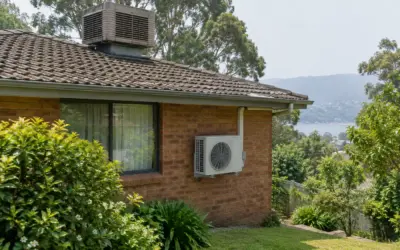
- Sensitive to bad power and corrosion. Power surges and salt air are both hard on electronics. That matters in beachside streets from Ettalong to Norah Head, where outdoor units cop salt spray year round.
- Sizing still matters. An inverter can slow down, but only so far. If the system is far too big for the room, it will still cycle on and off at its lowest speed and you lose much of the benefit.
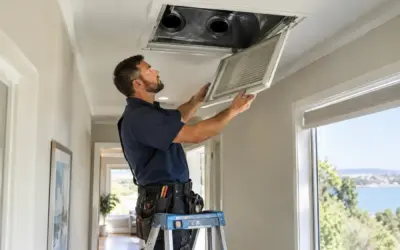
None of these are reasons to avoid an inverter. They are reasons to have it sized properly, installed well and serviced regularly, so the outdoor unit and its electronics are checked and cleaned before small problems become expensive ones.
When a non-inverter still makes sense
Honestly, not often. Inverter technology is now standard across most of the split and ducted systems on the market, and most fixed speed units we come across are older systems already in homes.
The cases where a fixed speed unit can be reasonable are narrow: a room you use a handful of times a year, such as a spare room for visiting family, where the lower purchase price matters more than running costs or comfort. Some budget window and portable units are also fixed speed. For a living area or a bedroom you use most nights, we would point you towards an inverter every time.
Got an old fixed speed unit? Here is how to decide
If your current system is working fine, there is no need to rip it out just because it is not an inverter. Keep it serviced and use it until it gives you a reason to change.
That reason usually turns up as a costly repair, a refrigerant leak, rising bills or a unit that simply cannot keep up on a January scorcher. At that point, putting repair money into an old fixed speed system is often harder to justify. Our guide on whether to repair or replace an ageing air conditioner covers the questions we ask before recommending either.
When you do replace it, the system should be sized to the room and the house, not just matched to whatever was on the wall before. Our team has more than 15 years of experience on the Central Coast, and a proper inverter split system installation starts with looking at the room, the orientation and how you actually live in the space.
Thinking about an upgrade?
If you are weighing up a new system from Gosford to Wyong, or anywhere in between, we are happy to come out, look at your home and talk you through the options without the sales pitch. Find out more about our air conditioning installations across the Central Coast and get in touch for an upfront quote.
Common questions about inverter air conditioners
Is an inverter AC better than a non-inverter?
For most homes, yes. An inverter holds a steadier temperature, runs more quietly and is generally cheaper to run when the system is used regularly. A non-inverter only really makes sense for a room used rarely, where the lower purchase price outweighs everything else.
What is the disadvantage of an inverter AC?
The main ones are a higher purchase price and more complex electronics, which can make some repairs dearer. The circuit boards are also sensitive to power surges and, near the beach, to salt air, so regular servicing of the outdoor unit is worth it.
Does an inverter air conditioner use less electricity?
Generally, yes, because it avoids the repeated full power restarts of a fixed speed unit and spends much of its time running at low speed. The actual saving depends on your home, how long the system runs and your electricity rate, so be cautious of one size fits all figures.
Should I leave an inverter air conditioner running all day?
On hot or cold days when someone is home, leaving it running at a sensible setting is usually better than switching it on and off. Each cold start makes it work at full power. If the house will be empty for most of the day, though, turning it off still makes sense.
How do I know if my air conditioner is an inverter?
Check the model on the indoor or outdoor unit, the energy rating label or the manual, which will usually say inverter if it is one. Another clue is behaviour: a fixed speed unit stops and starts with an obvious change in noise, while an inverter tends to slow down and keep humming.
Is an inverter worth it for a small bedroom?
Usually, yes. Bedrooms are where the quieter running and steadier temperature matter most, because the clunk of a fixed speed compressor restarting is exactly what wakes people up. The key is getting a unit sized for the room, not one that is far too big.