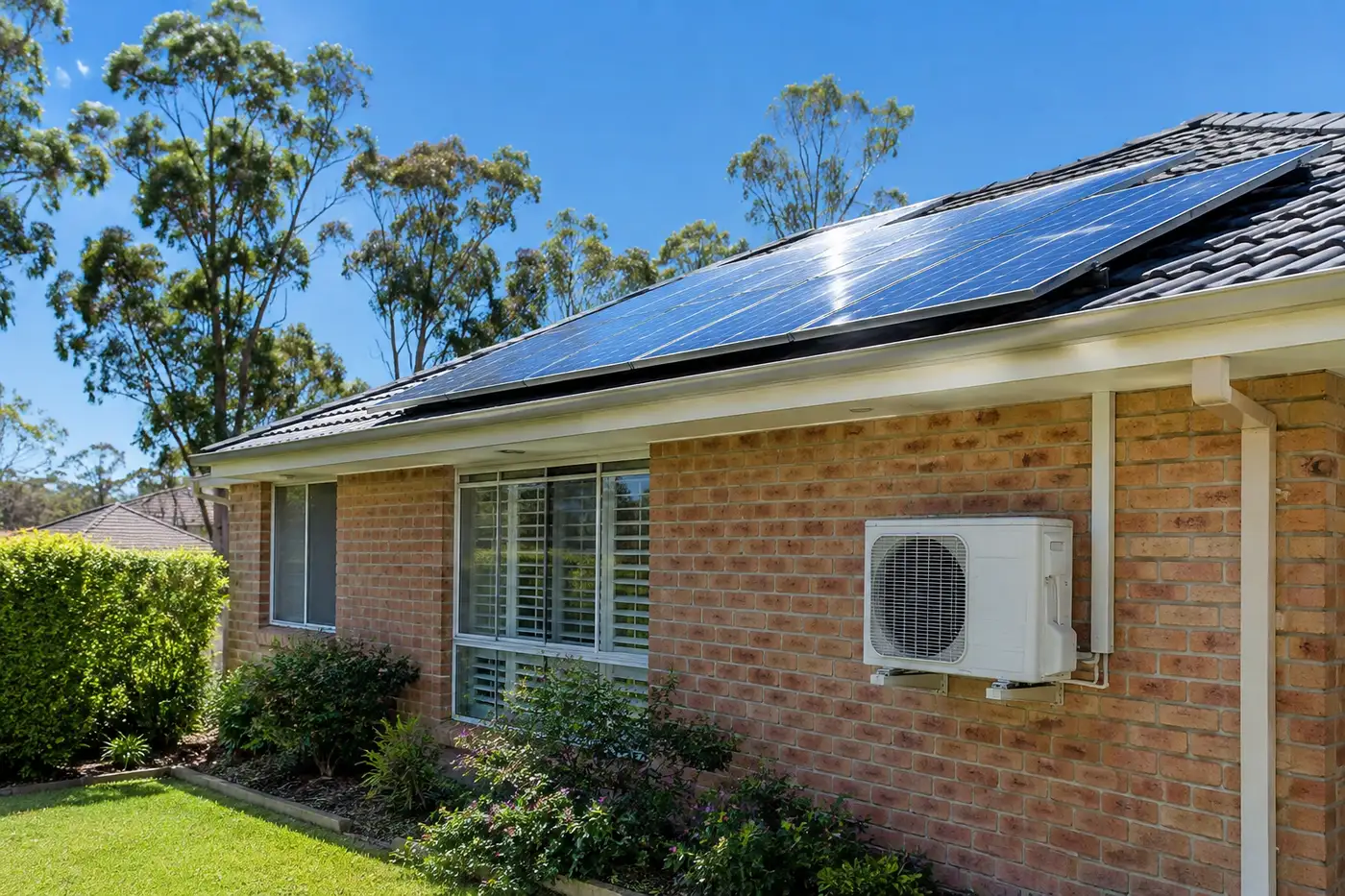
Every summer we hear some version of the same question from homes with panels on the roof: “We’ve got solar, so shouldn’t the air con be basically free?” It can come close. Running your air conditioner on solar panels is one of the best ways to cut cooling costs on the Central Coast, but the savings depend almost entirely on when the system runs.
The homes that end up with disappointing bills usually share a routine. The house bakes all day with nobody home, then the air con goes on flat out around 6pm, just as the panels stop producing. Change the timing and the picture changes with it.
Your panels can run the air con, but only while the sun is up
Solar panels make electricity during daylight. Your home uses that power first, and whatever is left over goes back to the grid in exchange for a feed-in credit. On most plans that credit is worth noticeably less than what you pay to buy power back from the grid at night. So every kilowatt hour (the unit your power bill counts in) that your air conditioner takes straight from your own roof is worth more to you than the same kilowatt hour exported.
The catch is obvious once you say it out loud. When the sun goes down, so does your free power. Unless you have a home battery, an air conditioner running at 8pm is running on grid electricity at full price, solar or not. If you want the bigger picture on what cooling costs from the grid, our breakdown of air conditioning running costs on the Coast covers it.
Cool the house early and let it coast into the evening
This is the biggest change most solar households can make, and it costs nothing. On a hot day, start the air conditioner late morning or around lunchtime while the panels are producing strongly. Bring the house down to a comfortable temperature and hold it there through the afternoon.
What you are really doing is cooling the whole building, not just the air. Walls, floors, a concrete slab and even the couch soak up heat through the day. If they are already cool when the sun drops, the system only has to hold the temperature in the evening. That is far easier work than pulling down a house that has been storing heat since breakfast.
A few habits help it along:
- Blinds and curtains closed on west and north facing windows before the afternoon sun reaches them
- Doors and windows shut while the system runs
- The timer or Wi-Fi app set to start cooling before you get home from work
- The dryer, dishwasher and pool pump kept out of the hottest part of the afternoon if your solar is stretched
The Coast adds its own wrinkle. Beachside homes in places like Terrigal or Avoca Beach often get relief from the afternoon sea breeze. Homes further inland, around Wyong, Lisarow or Kariong, can hold the heat well into the night. That second group gets the most out of cooling early, because their worst hours run past sunset.
An inverter system handles passing cloud far better
Most split systems sold today use an inverter compressor. In plain terms, the motor speeds up and slows down to match demand instead of switching fully on and off. Once a room reaches temperature, an inverter unit idles along at low power.
That suits solar well. Output from your panels rises and falls through the day, and a system that sips power once the room is cool has a much better chance of staying inside what the roof is producing. Older fixed speed units cycle between full power and nothing, and on a patchy day those bursts often land just as a cloud knocks your output down. We’ve compared the two properly in our guide to inverter and non-inverter units.
Two numbers tell you whether your solar can keep up
You don’t need to be an electrician to get a rough answer, and you can find both numbers yourself.
The first is your air conditioner’s power input, listed in kilowatts (kW) on the spec sheet or the label on the unit. This is not the cooling capacity in the model name. An air conditioner moves heat rather than making it, so it usually draws well under its cooling size in electricity.
The second is what your solar is producing at midday on a clear day. Most solar inverters have an app or a display that shows this live. Compare the two, then leave room for the fridge, lights and anything else running at the same time. If production comfortably covers the lot, the sun is paying for most of your daytime cooling. If it doesn’t, the air con still works perfectly well. It just tops up from the grid.
Homes with several split systems, or a ducted system running every zone, can outrun a modest solar setup on a hot afternoon. Cooling only the rooms you are actually using makes a real difference here, and with ducted systems, closing zones you don’t need cuts the load straight away.
One more thing that surprises people: a dirty system wastes solar. Clogged filters and grimy coils make the unit work harder for the same result, which eats more of your midday output. A clean, serviced system simply goes further on the same panels.
Batteries carry the savings past sunset
A home battery stores spare daytime solar so you can use it in the evening, which is exactly when many Coast households want cooling most. Whether a battery stacks up financially depends on your solar system, your power plan and how your household uses energy, and that is a conversation for a solar specialist.
From the air conditioning side, the rule is the same either way. An efficient, correctly sized system drains a battery far more slowly than an oversized or poorly maintained one.
“Solar air conditioners” are a niche product for most homes
Search for solar air conditioning and you will find hybrid units with their own panels wired directly to the outdoor unit. They have a place, mostly in off-grid cabins, sheds and spots with no rooftop solar to draw from.
For a typical Central Coast house that already has panels on the roof, a standard reverse cycle inverter system connected to the home’s power supply gets the same daytime benefit. You also keep a much wider choice of models and sizes.
Winter heating runs on the same sunshine
Reverse cycle air conditioning heats as well as cools, and the same timing trick works in winter. Days are shorter and solar output drops, but a sunny winter afternoon is still a good time to warm the house before the evening chill sets in. Starting the heat at 3pm on solar rather than at 6pm on the grid adds up across a season.
Planning a new system around your solar
If you are replacing an old unit or adding air conditioning to a home with solar, it pays to think about the two together. The right size for your rooms, an inverter compressor and Wi-Fi control so you can start cooling from work are the three things we’d put at the top of the list for a solar home. Our team has over 15 years of experience on the Central Coast, and you can see how we approach a new system on our air conditioning installation page.
Common questions about running air con on solar
Can I run my air conditioner all day on solar?
On a clear day, yes, as long as your panels are producing more than the air con and the rest of the house are drawing. Running it through daylight hours is often cheaper than switching it on in the evening, because the power is coming from your roof instead of the grid. Once the sun drops, it draws from the grid unless you have a battery.
How does solar powered air conditioning work?
In most homes it isn’t a special type of air conditioner at all. Your panels feed the house, and the air conditioner uses that power like any other appliance. Hybrid units with panels wired straight to the outdoor unit do exist, but they mainly suit off-grid sites.
Why is my electricity bill still high when I have solar panels?
Very often it comes down to timing. If the big appliances, including the air con, run mostly in the evening, you are buying grid power at full price while your daytime solar is exported for a smaller credit. Shifting cooling into daylight hours and keeping the system clean are two of the easiest fixes.
Can a small solar system run a split system?
It depends on the split system’s power input and what else the house is drawing at the time. Check the input figure on the unit’s spec sheet against what your solar app shows at midday. A smaller solar system can often carry a single split on a sunny afternoon, but running several units at once will usually pull some power from the grid.
Do I need a battery to run my air conditioner on solar?
No. Your air conditioner uses solar power directly during the day without one. A battery only extends that benefit into the evening and overnight.
Thinking about a new system that works with your solar rather than against it? Talk to our team about a split or ducted installation sized for your home, and we’ll help you get the most from every sunny afternoon.