A couple in Terrigal had just finished renovating their kitchen and living area. It was one big open room with glass doors along one side and cabinetry along the other. Their old wall split had come out with the old wall, and now they had nowhere to put a new one. Then the builder asked about a ceiling cassette air conditioner, and they had no idea whether that was a good idea or an expensive one.
It’s a fair question, and we hear it more often now that open-plan layouts are the norm. A cassette is a lot like a split system, just with the indoor unit moved into the ceiling. That one change brings real advantages and a few catches. This guide sets them out side by side so you can tell which one actually suits your home.
A cassette is a split system that lives in the ceiling
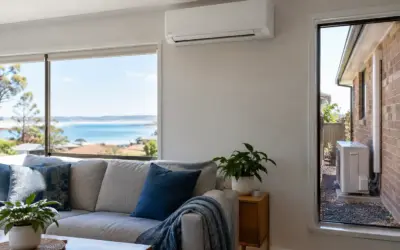
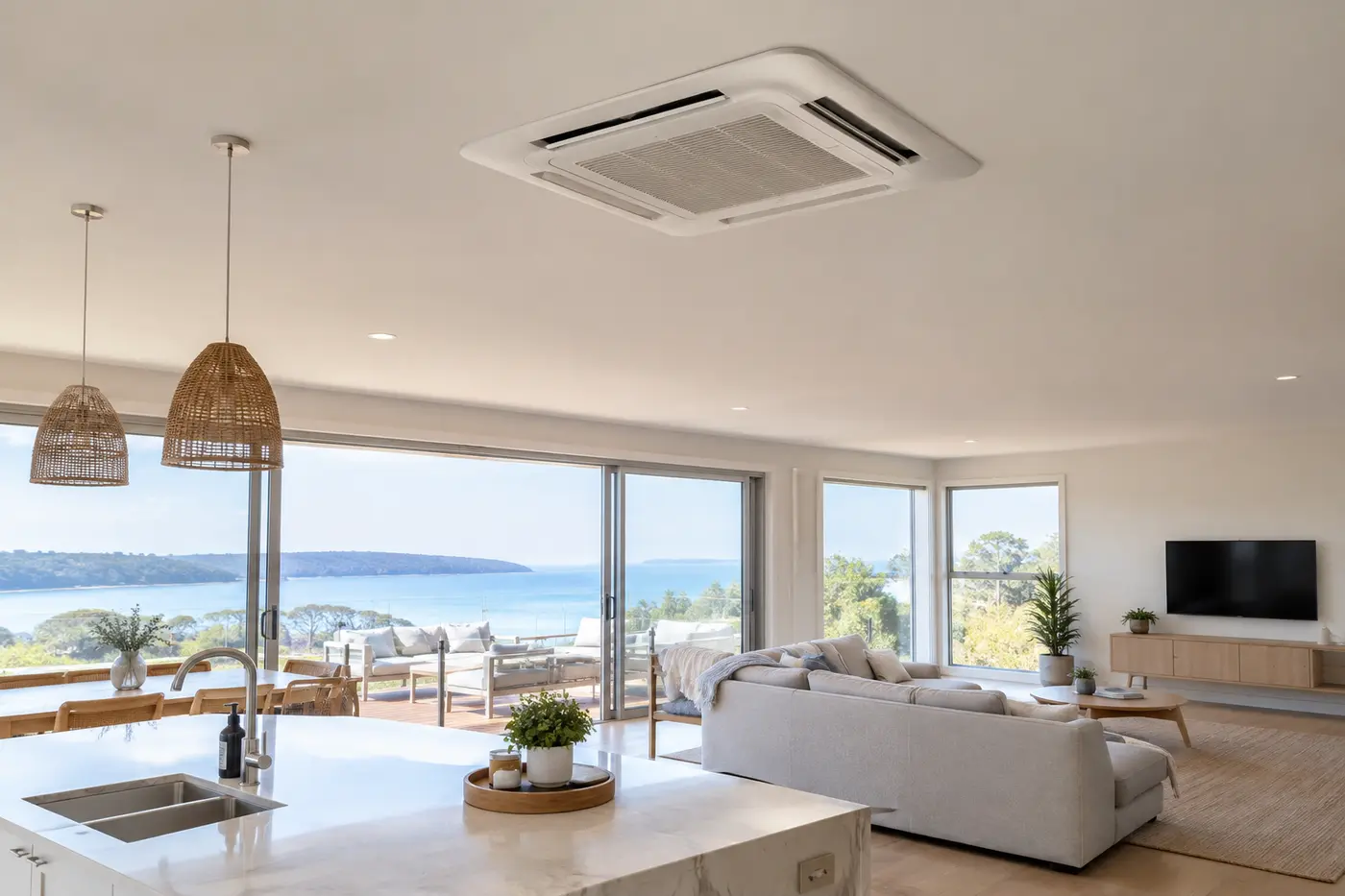
A standard wall split has two parts: an indoor unit on the wall and an outdoor unit (the compressor) outside, joined by refrigerant pipes. A ceiling cassette works the same way. The difference is where the indoor unit goes. It sits up in the ceiling space, and all you see from the room is a square grille sitting flush with the plaster.
Most cassettes push air out of four sides at once, which is why you’ll see them called 4-way units. Some compact models blow in one direction only and suit narrower rooms. Either way, it’s still one indoor unit heating and cooling one area. That’s what separates a cassette from a ducted system, which feeds the whole house through hidden ductwork.
Where a cassette clearly beats a wall unit
The biggest win is airflow. A wall split pushes air from one side of the room, so the far end can feel stuffy while whoever sits under the unit gets blasted. A 4-way cassette in the middle of the ceiling spreads air more evenly in every direction. In a long open kitchen, dining and living space, that difference is easy to feel.
Then there’s wall space. Plenty of the homes we look at around the coast have big windows or sliding doors facing the view, and those walls can’t take a unit. Kitchens are worse, with overhead cupboards and rangehoods fighting for every spare spot. A cassette takes up no wall at all.
Looks matter to a lot of people too. A cassette grille is fairly discreet once the room is painted and furnished. Some owners find it tidier than a white box on the wall, especially in a freshly finished renovation.
The catches people don’t hear about until the quote
None of these is a deal breaker. You just want to know about them before you commit.
You need the right ceiling
The cassette body has to fit in the space above your ceiling, between the joists or trusses. A single-storey home with a roof space above is usually straightforward. The ground floor of a two-storey house is harder, because there’s a floor sitting above the ceiling and often not enough room. Raked or cathedral ceilings usually rule a cassette out altogether. This is the first thing we check, because there’s no point comparing models if the unit can’t physically go in.
The water has to go somewhere
Every air conditioner pulls moisture out of the air when it cools, and on the Central Coast that’s a lot of water on a humid summer day. A wall split can usually drain by gravity down the outside wall. A cassette sits higher and further from an outside wall, so most have a small built-in pump that lifts the water into the drain line. Pumps work well, but they’re one more part that needs checking and that can eventually fail. If you’ve read our guide to air conditioners leaking water, you’ll know drainage problems come up constantly. A blocked cassette drain drips through a ceiling instead of down a wall.
It usually costs more to buy and install
There’s more work involved: cutting the ceiling, securing the unit to the frame, running pipes and power through the roof space, and fitting the drain and pump. The unit itself also tends to cost more than a wall split of similar capacity. How big the gap is depends on the home, so treat any online price as rough until someone has looked at your ceiling.
Servicing means a ladder and a bit more time
Cleaning a cassette filter means getting up to the ceiling and dropping the grille. It’s not hard, but it’s less handy than flipping up the front of a wall unit at shoulder height. A full professional clean takes a little longer for the same reason.
Coastal humidity makes upkeep matter more
Our climate is hard on any indoor unit. Warm, damp air plus a cold coil makes ideal conditions for mould, and in a cassette that coil and drain tray sit out of sight in the ceiling. Most owners never look at them. We recommend a professional clean at least once a year for any system, and more often if you run it daily or have pets or allergies. That advice goes double for a cassette, because a smell or a slow drip is often the first sign anything’s wrong.
The outdoor unit faces the same salt air whichever indoor unit you choose, so that part of the decision is a draw.
Cassette or wall split: how we’d decide
We’ve spent over 15 years working on systems across the Central Coast, and this is roughly how we’d talk it through with you.
A cassette makes sense when:
- the room is large or open plan and a wall unit would leave cold or hot spots
- there’s no suitable wall because of windows, doors or cabinetry
- there’s clear roof space above with room for the unit and the drain
- you care about a clean look and don’t mind paying a bit more for it
A wall split is usually the better call when:
- it’s a bedroom, study or average-sized living room
- you’re on the ground floor of a two-storey home or under a raked ceiling
- budget is the main concern
- you’d like to clean the filters yourself without dragging out a ladder
If you need to cool several rooms but ducted isn’t an option, there’s a middle path. Some multi head split systems let you mix indoor units, so a cassette can go in the open living area and wall units in the bedrooms, all running off one outdoor unit.
The ceiling space question has to be answered on site, so that’s the place to start. Our team can take a look as part of our air conditioning installation service, check what’s above your ceiling and tell you plainly whether a cassette or a wall split will do the better job in your room.
Common questions about ceiling cassette air conditioners
Are ceiling cassette air conditioners good?
Yes, in the right room. They spread air evenly from the centre of the ceiling and take up no wall space, which makes them a strong choice for big open living areas. In a small bedroom they’re usually more cost and effort than the room needs.
What are the disadvantages of a cassette AC?
The main ones are a higher up-front cost, the need for enough space above the ceiling, and a condensate pump that has to be kept in good order. Filters and cleaning are also less convenient because the unit is overhead.
Which is better, a cassette or a wall split system?
Neither is better across the board. A cassette wins on even airflow and looks in large or awkward rooms, while a wall split wins on price, simpler installation and easier upkeep in ordinary rooms. The room shape and what’s above your ceiling usually decide it.
What are some common problems with cassette air conditioners?
Most of the trouble we see comes from drainage: a blocked drain line or a failed pump that lets water drip through the ceiling. Mould in the coil and drain tray is the other one, especially in humid coastal homes where the unit hasn’t been cleaned for a while.
Can a ceiling cassette heat as well as cool?
Most cassettes sold for homes are reverse cycle, so they handle winter heating as well as summer cooling. Warm air rises, so in heat mode the louvres are usually angled to push air down towards the floor rather than letting it sit up near the ceiling.