It’s the first properly warm weekend of spring. You point the remote at the bedroom split system, press the button, and nothing happens. No beep, no flap opening, no little green light. If your air conditioner is not turning on, the good news is that a fair share of the calls we get about this end with a simple fix the owner could have found in a few minutes. The rest need a technician, and knowing which is which saves you time and a call-out.
Everything below is safe for anyone to do. Nothing involves taking covers off or touching wiring. Please don’t.
Not turning on can mean four different things
Before you check anything, take a moment to notice exactly what the system is doing. It narrows things down quickly.
- Completely dead. No lights on the indoor unit, no beep when you press the remote.
- Lights on, nothing else. The unit beeps or shows a light but the fan never starts.
- Indoor fan runs, outdoor unit stays quiet. Air moves, but it’s room temperature.
- Starts, then stops. It runs briefly and shuts itself off, sometimes with a flashing light.
A completely dead unit is usually a power or remote problem. The other three lean more towards a fault inside the system, though not always.
Five checks you can do without a screwdriver
1. The remote is the culprit more often than you’d think
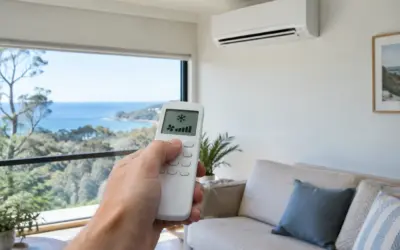
Flat batteries are the classic one, especially on a unit that sat untouched all winter. If the remote screen is faint or blank, swap the batteries before anything else. Then point it straight at the indoor unit from across the room and try again. Many split systems also have a small manual button on the indoor unit itself, often tucked behind or under the edge of the front panel. Your owner’s manual will show where. If the unit starts from that button, the problem is the remote, not the air conditioner.
2. Check the mode, the timer and the set temperature
This one surprises people. If the unit is on Cool but the target temperature is higher than the room already is, it has nothing to do, so the compressor (the pump in the outdoor unit that does the actual cooling) won’t start. Same if it’s on Fan only, or if someone has set an on or off timer. Kids, visitors and cleaners press buttons. If the icons on the screen don’t make sense, our guide to what each symbol on your remote means will sort it out quickly.
3. Look at the switchboard
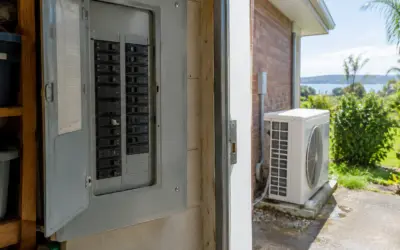
Most air conditioners have their own circuit in the switchboard, usually labelled AC or air con. If that switch has dropped to off, flick it fully off, then firmly back on. If it stays on and the unit starts, great. If it trips again, leave it off. A breaker that keeps tripping is protecting you from something, and we’ve written a separate guide on why an air con keeps tripping the power that explains the likely causes.
4. Find the isolator switch next to the outdoor unit
Mounted on the wall beside the outdoor unit there’s normally a weatherproof switch box. That’s the isolator, and it lets a technician cut power safely while they work. It’s also easy to knock off. We regularly find them switched off after house painting, gutter cleaning or a gardener working along that side of the house. If yours is off, turn it on, then give the system a few minutes.
5. Wait three minutes before you decide it’s broken
Most modern systems have a built-in delay of around three minutes before the compressor restarts. It protects the compressor from being switched on and off too quickly. So if you’ve been pressing the remote over and over, put it down, wait, and try once more. Plenty of dead air conditioners have come back to life during that pause.
A storm or blackout can leave it needing a reset
Summer storms roll through the Central Coast most years, and power cuts or surges can leave a system confused. A simple reset often helps: turn the unit off at the switchboard breaker for a few minutes, then back on, and try the remote again. If it’s still dead after a storm, the control board (the circuit board that acts as the unit’s brain) may have taken a surge. That’s a repair job, and it’s better to get it checked than to keep cycling the power.
Signs it’s time to stop and call a technician
Once you’ve done the five checks above, further poking around isn’t safe or useful. These are the situations we’d want you to leave alone:
- The breaker trips again straight after you reset it
- A flashing light or error code on the indoor unit
- A burning or hot electrical smell
- The outdoor unit hums but its fan doesn’t spin
- The system starts and then shuts down, over and over
- Water dripping from the indoor unit along with the shutdown
Behind those symptoms we usually find one of a short list of faults. A failed capacitor (a small part that gives the motors their starting kick) is common in older units. Control boards fail, particularly after surges. Ducted systems often have a safety switch that shuts everything down when the condensate drain blocks and water backs up, which is a good thing, because the alternative is a stained ceiling. Low refrigerant can also make a unit shut itself off, and handling refrigerant requires specific licences, so that’s never a home fix.
Living close to the coast plays a part too. Salt air speeds up corrosion on outdoor units, and in beachside homes from Umina Beach to The Entrance we see more corroded terminals and connections than we do further inland. A unit that worked fine in autumn can refuse to start in spring for exactly that reason.
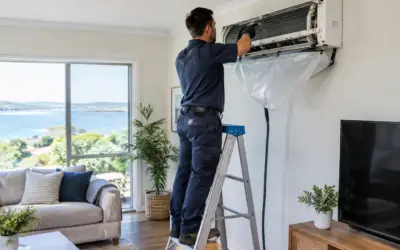
If you’ve ticked off the easy checks and it still won’t go, our team handles air conditioning repairs across the Central Coast, from a single bedroom split system to whole home ducted systems. We’ll diagnose the actual fault and explain the options before any work starts.
Spring is when a quiet fault finally shows itself
A lot of units sit unused for months between seasons, and small faults only show up the first time the system is asked to work hard. We also sometimes find ants nesting in outdoor units, drawn to the electrical contacts. The easy fix is to switch yours on and run it for a short while now, before the first really hot day. A regular professional service catches worn parts before they fail, and many manufacturers require proof of regular servicing to keep the warranty valid.
With over 15 years of experience on the Central Coast, we’ve seen just about every reason an air conditioner refuses to start. If yours has gone quiet and the checks above haven’t brought it back, book a repair visit and we’ll find the fault and get you comfortable again.
Common questions when an air con won’t start
How do you reset an air conditioner that won’t turn on?
Turn the system off at its circuit breaker in the switchboard, wait a few minutes, then switch it back on and try the remote. If there’s an isolator switch next to the outdoor unit, make sure it’s on as well. If the breaker trips again or the unit still won’t start, leave it off and call a technician.
How do I force my AC to turn on without the remote?
Many split systems have a manual or emergency button on the indoor unit, often under or behind the edge of the front panel. Pressing it usually runs the unit in an automatic mode. Check your owner’s manual for the exact spot. If the unit starts this way, the remote or its batteries are the likely problem.
What would cause my AC not to kick on?
The most common reasons are flat remote batteries, the wrong mode or set temperature, an active timer, a tripped breaker or an isolator switched off. If all of those check out, likely causes include a failed capacitor, a faulty control board, a blocked drain triggering a safety switch, or low refrigerant.
Why did my air conditioner suddenly stop working?
A sudden stop is often a protection feature doing its job. The system may have tripped its breaker, detected high water in the drain tray, or shut down because of a fault it picked up. A flashing light or error code on the indoor unit is a strong hint, so note the pattern before you call.
What is the 3-minute rule for air conditioners?
Most systems wait around three minutes before restarting the compressor after being switched off. The delay stops the compressor from short cycling, which can damage it. If you’ve just turned the unit off and on, give it that time before assuming it’s faulty.
Why is my outside AC unit not turning on when the inside one is?
First check the isolator switch beside the outdoor unit and confirm the remote is set to Cool or Heat with a target temperature that gives the system something to do. If those are right and the outdoor unit still stays silent, or hums without its fan spinning, it’s usually an electrical fault such as a capacitor or control problem that needs a technician.